
Lucas County Sex Offender Checks
The Lucas County Sheriff's Office performs the local registration role for people who register outside Iowa Department of Corrections prerelease work. The sheriff sends registration information to DCI, which publishes the public fields. Call the sheriff at 641-774-5083 for Lucas County appointment or registration questions because the county does not publish an online appointment schedule or fee. A public search does not replace that official contact when a status seems wrong or a recent move has not yet appeared.
Start with facts that can separate people who share a name. A middle name, alias, age, city, ZIP code, or OCI/ISOR number can help. Then compare the result's photo, address history, conviction text, and last-change data. For an event that presents an immediate threat, call 911 rather than trying to confirm it through a web search.
Lucas County Registry Hourly Updates
The Iowa Sex Offender Registry is the main public source for a Lucas County sex offender lookup. DCI operates the system under Iowa Code chapter 692A, and the registry dates to July 1995.
Iowa says the public data is typically refreshed each hour on business days from Monday through Friday. That makes the Lucas County registry the fastest published view after DCI posts a change, but it does not erase reporting lag between a Lucas County registration event and state publication.
Lucas County Registry Search Modes
Iowa offers five search modes, and each answers a different Lucas County question. Basic search works well when a name or ZIP code is known. Advanced search adds county, age, body measurements, aliases, and an OCI/ISOR number. Map search starts with a street location and range. Telephone and email searches help determine whether contact information is associated with a registrant. None should be treated as a substitute for the others when the first result is unclear.
A name search can miss an alias unless that option is selected. Place searches can catch a record when the exact spelling is unknown. The Lucas County dropdown narrows local results, while nearby-city and nearby-postal options can widen a boundary-sensitive search. For a person who may have moved across Iowa's border, the U.S. Department of Justice National Sex Offender Public Website adds participating jurisdictions nationwide. It is the sound second layer when a Lucas County lead points beyond Iowa.
These modes compare reported registration details. They do not prove that every person at an address is registered, nor do they supply the full court history behind a conviction. Use the result as a lead for closer review.
Iowa Sex Offender Registry Searches
A focused Lucas County sex offender search takes four steps. The public interface accepts several optional fields, so a broad first pass can be narrowed after results appear. Too many filters may hide a valid record when a name, age, or address has changed.
- Open the official Iowa registry and choose basic, advanced, map, telephone, or email search based on the facts already known.
- For a geographic search, select Lucas County or enter a local city, ZIP code, or street location and range. For a person search, add the name and alias option.
- Compare the result list with known identifiers. Check the photo, age, aliases, location, and OCI/ISOR number before treating a profile as a match.
- Open the full record, note its status and last change, then confirm questions with the Lucas County sheriff or DCI rather than drawing conclusions from one field.
The official fields below show how broad a Lucas County registry check can be. Most are optional. A range is required only for the location route, and map or list controls change how geographic results appear.
| Field or mode | Type | Required | Use in a Lucas County search |
|---|---|---|---|
| Last and first name | Text | No | Starts-with match for each name |
| Also Search Aliases | Checkbox | No | Includes alternate reported names |
| ZIP code | Text | No | Basic geographic field |
| OCI/ISOR number | Text | No | Searches a known registry identifier |
| Gender | Choice | No | Narrows advanced or data searches |
| City or nearby city | Text and checkbox | No | Finds the named place or nearby places |
| County | Dropdown | No | Select Lucas for county results |
| Postal or nearby postal | Text and checkbox | No | Uses a postal area and optional nearby range |
| Age, height, weight | Number | No | Age and height allow plus or minus 3; weight allows plus or minus 20 |
| Street, city, state, postal | Location route | For map route | Builds an address-radius search |
| Range | Number or select | Yes for location | Sets miles around the entered place |
| Telephone or email | Dedicated search | Input needed | Checks contact data associated with a registrant |
| Map/List and Create Watch | Controls | No | Changes the view or starts a notice watch |
Note: A wider Lucas County search is often more useful than stacking several uncertain filters in the first query.
Lucas County Registry Address Watches
A watch changes a one-time Lucas County registry lookup into an ongoing notice. Iowa says watch emails are sent within 60 minutes when covered registration data changes. Through My Account and My Watches, a user can track an address and receive move-in, move-out, and within-area alerts. This is the state's practical form of neighborhood notification because the Iowa FAQ says sheriff or police staff are not required to notify each nearby household one by one.
Create the watch from a location result instead of relying on a saved list of names. That approach tracks the area even when the person tied to the next change is not yet known.
- Sign in to the Iowa registry account area and run a map or address search for the Lucas County location.
- Choose Create Watch and confirm the place and area shown by the registry.
- Manage the entry under My Watches and keep the account email current.
- Read each notice as a prompt to open the current public profile and verify the change.
A watch is a notice tool, not an emergency alert service. Call 911 for immediate danger. Direct routine questions about a Lucas County registration to the sheriff, and direct registry-system questions to DCI at 515-725-6050.
Registry Profiles: What They Show
An Iowa registry profile combines identity, location, conviction, and compliance data. The public schema supports a careful field inventory without reproducing any resident's personal record. Some details, including convictions, aliases, wanted status, and skin markings, appear in data results only when a request returns 25 or fewer records. That limit is another reason to narrow a broad Lucas County result before comparing profiles.
| Identity | Registrant and OCI identifiers, name, aliases, gender, date of birth, and age |
|---|---|
| Appearance | Latest photo URL plus reported skin markings when available under the result limit |
| Location | Primary address, city, ZIP, Lucas County, coordinates, distance, and address effective or change date |
| Conviction | Conviction text, age at offense, victim age group and gender, and victim-count categories |
| Status | Most-wanted or noncompliance indicator, cluster count at an address, and last-changed timestamp |
| Result controls | Page and per-page controls, with sorting by identifiers, names, or gender |
The Iowa registry's official data documentation shows the schema used for these public fields.
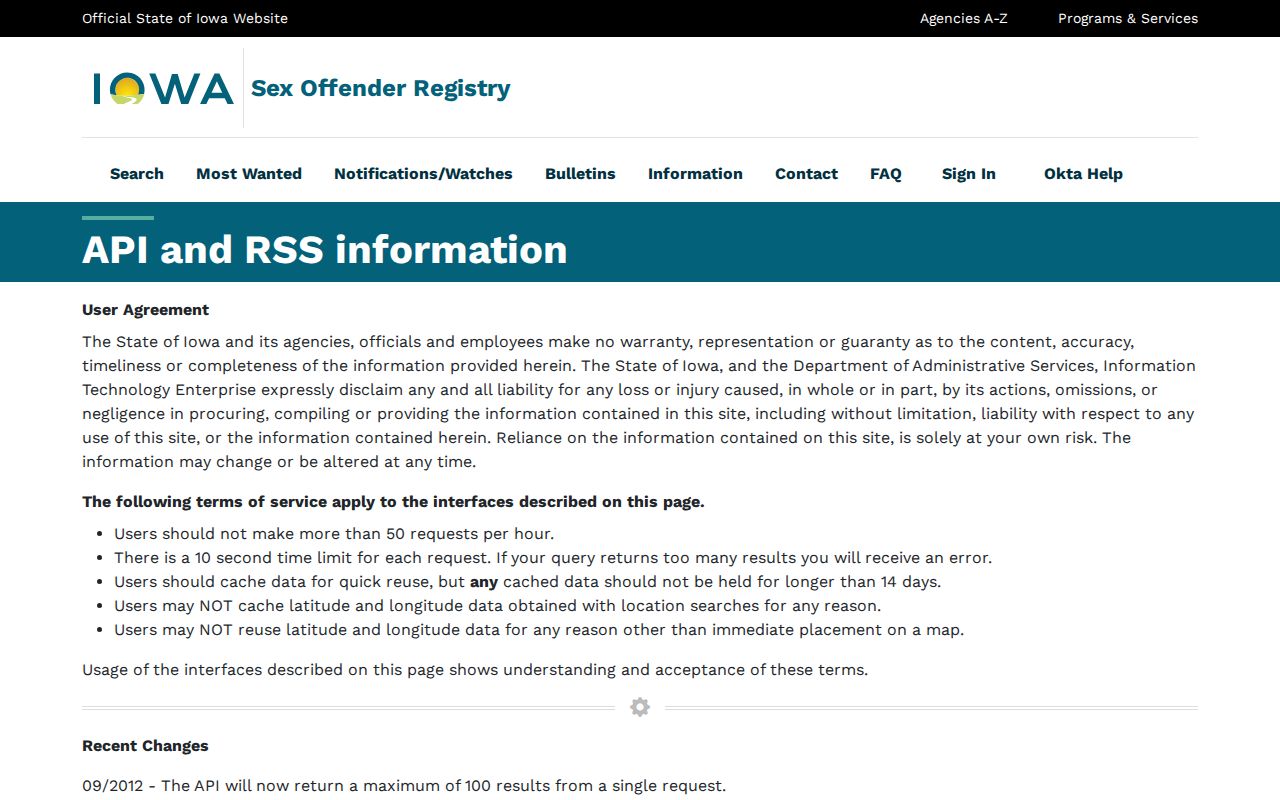
The field list helps a Lucas County reader distinguish published registration facts from details that must be checked in the court record.
Lucas County Registry Data Flow
Registration and publication are separate steps. A Lucas County sheriff's registration action creates or confirms local data. The sheriff then forwards the information to DCI. DCI maintains the central registry and publishes the public fields. Iowa DOC may complete prerelease registration for a covered person leaving custody, but the same person may later report changes through the county registration process.
Supervision is separate too. The Iowa DOC Fifth Judicial District serves Lucas County with probation, parole, pretrial services, electronic monitoring, and other programs. Those services concern correctional supervision. They do not turn a public registry profile into a complete supervision record, and registration may last beyond a sentence or supervision term.
The Iowa DOC Fifth Judicial District page identifies the district that provides community-based correctional services in Lucas County.
This Lucas County district view keeps three roles distinct: the sheriff registers locally, DCI publishes the registry, and Iowa DOC handles correctional supervision.
Registration Levels and Duties in Iowa
Iowa Code chapter 692A classifies covered offenses and sets registration periods. Sections 692A.102 through 692A.107 address who must register, offense tiers, duration, and verification. The broad periods below are starting points, not a result that should be guessed from a charge name. Tolling, statutory exceptions, recidivist rules, and the exact adjudication can change the outcome.
| Iowa statutory category | General duration | Visibility and verification |
|---|---|---|
| Tier I offense | Generally 10 years | Public data follows chapter 692A; check current §692A.106 for exceptions and tolling |
| Tier II offense | Generally 25 years | Public data follows chapter 692A; confirm the exact statutory verification duty |
| Tier III offense | Generally lifetime | Public data follows chapter 692A; do not infer a personal risk rating from the tier |
| Sexually violent predator or specified recidivist circumstance | Lifetime may apply | Public registration and heightened verification can apply under chapter 692A |
Out-of-state, juvenile, deferred-judgment, and federal adjudications may trigger Lucas County registration duties through statutory equivalency. The registry states that covered crimes against a minor, sexual exploitation, and sexually violent crimes can require registration. A person on supervision or in custody on or after July 1, 1995 may also fall within the statute's covered circumstances.
The Iowa Board of Parole's official site shows the separate authority that makes state release decisions.
A parole decision and a Lucas County registry duty answer different legal questions, so one should never be used to assume the other.
Lucas County Registry Tiers Aren't Risk Scores
The common mistake is to read Tier I, II, or III as a simple low, medium, or high danger scale. Iowa's tier structure is based on statutory offense classifications and registration duties. It does not give a reader permission to predict what a person will do. The sound reading is narrower: identify the category, review the reported conviction and status, and consult the current statute when duration or verification matters.
A charge label alone may not reveal the tier. A final adjudication, an equivalent conviction from another jurisdiction, a covered juvenile adjudication, or a federal case can affect the analysis. Registry status also is not the same as guilt on a new allegation. When the judicial details matter, the Lucas County court case lookup explains how to read the filed charge, disposition, orders, and sentence in the clerk's record.
Use the profile for registration status and reported location. Use the current case file for the judicial path. Keeping those records apart prevents a Lucas County registry result from being stretched beyond what its fields can prove.
Using Registry Information Lawfully
Registry information supports safety planning and community awareness. It does not authorize threats, intimidation, harassment, exclusion, or self-directed enforcement. Iowa's watch system supplies address-based notices, while the state's Most Wanted feature identifies absconders or noncompliant registrants and tells the public not to apprehend them. Report a concern through law enforcement.
Misuse is a crime: Iowa Code §719.8 prohibits using sex-offender-registry information to commit a criminal offense against a registrant or a member of that person's household. Never threaten, intimidate, harass, or attempt to apprehend anyone.
Individual neighborhood notice by a Lucas County sheriff or police officer is not required under the registry FAQ. Address watches provide move-in, move-out, and within-area changes instead. For an urgent threat, call 911. For routine Lucas County reporting, call the sheriff at 641-774-5083. Registry system and noncompliance questions can also be directed to DCI at 515-725-6050.
Plain restraint matters. A match may involve an old address, a shared name, or a field that changed after the last update. Confirm the person, read the last-change details, and let public officers handle compliance work.
Lucas County Registry Noncompliance Reports
A missing or conflicting Lucas County entry calls for a report, not a confrontation. First capture the registry URL, the listed OCI/ISOR number if shown, the field that appears inconsistent, and the time of the search. Do not follow a person, enter private property, or publish an accusation. A registry update may already be moving from the sheriff to DCI, and a search filter may also explain an apparent gap.
Call 911 when conduct creates an immediate emergency. Otherwise, contact the Lucas County Sheriff's Office at 641-774-5083 or the Iowa registry at 515-725-6050. Iowa's Most Wanted page is reserved for listed absconders or noncompliant registrants. Its warning is direct: do not attempt apprehension. Tips belong with DPS or local law enforcement.
A Lucas County registry listing is also not a full criminal case. It answers whether the state publishes a registration record, along with the qualifying offense and reported place data. Court pleadings explain how the case moved, and agency files may carry facts that are restricted from public release. Each source has a distinct job.